
Atelier Christof Cremer
Christof Cremer is an internationally active costume and set designer as well as a scenographer. Born in Germany, he runs an interdisciplinary studio in Vienna and develops a wide range of artistic projects in collaboration with a multidisciplinary team. The studio combines artistic, scientific, and technical expertise to translate concepts into spatial and visual design.

In collaboration with curators, historians, art historians, and experts in art history, graphic design, photography, illustration, architecture, multimedia, and stage design, we develop concepts and execute projects for museums and exhibitions, memorial sites and remembrance culture, major European stages, festive productions, and projects in the field of sacred art.
Translating Content into Form—A Metamorphosis

THEATER
The set and costumes bring the play to life
Whether it’s musical theater, spoken-word theater, musicals, operettas, ballet, or dance—our set designs and costumes for numerous European theaters are always an integral part of the overall theatrical concept. The interplay of music, space, costumes, and the artists’ expressiveness gives rise to vivid images and magical moments.
>> Read more
Salomé
based on the drama of Oscar Wilde
Opéra National Capitole Toulouse
Premiere: May 22, 2026
Musical Director: Frank Beermann
Directed by: Matthias Goerne
Set Design: Hernán Peñuela
Costumes: Christof Cremer
Lighting: Vinicio Cheli
Choreography: Beate Vollack
Cast:
Salome: Nicole Chevalier/Florina Stucki; Johanaan: Jerome Boutillier; Herod: Nikolai Schukoff; Herodias: Sophie Koch; Narraboth: Favien Hyon; a Page: Floriane Hasler; 1st Jew: Damien Bigourdan; 2nd Jew: Emmanuel Hasler; 3rd Jew: Alfredo Poesina; 4th Jew: Zachary McCulloch; 5th Jew and Cappadocian: Baptiste Bouvier; 1st Soldier: Julien Véronèse; 1st Nazarene and 2nd Soldier: Matthieu Toulouse; 2nd Nazarene: Hun Kim; a Slave Girl: Katharina Semmelbeck
© Copyright: Photographs by Cosimo Mirco Magliocca
https://www.mircomagliocca.com/
Capitol National Opera of Toulouse
https://opera.toulouse.fr/
Der Ignorant und der Wahnsinnige
Reichenau Festival
Premiere: July 21, 2024
Directed by Hermann Beil
Costume and Set Design: Christof Cremer
Lighting: Marcus Loran
Dramaturgy: Angelika Messner
© Photos: Barbara Palfy
Cast:
Königin der Nacht: Julia Stemberger
Vater: Martin Schwab
Doktor: Stefan Jürgens
Frau Vargo: Therese Affolter
Kellner Winter: Dirk Nocker
Link to the Reichenau Festival:
https://www.festspiele-reichenau.at/de/spielplan/der-ignorant-und-der-wahnsinnige/3088
The Evil Spirit Lumpazivagabundus, or The Wayward Cloverleaf
, by Johann Nepomuk Nestroy
Reichenau Festival
Premiere: August 4, 2024
Directed by Robert Meyer
Costume and Set Design: Christof Cremer
Lighting: Friedrich Rom
Music: Helmut Thomas Stippich
Dramaturgy: Angelika Messner
© Photos: Barbara Palfy
Cast:
Leim, a carpenter’s apprentice: Thomas Frank
Zwirn, a tailor’s apprentice: Florian Carove
Knieriem, a shoemaker’s apprentice: Robert Meyer
Lumpazivagabundus: Sebastian Wendelin
Stellaris/Pantsch/Hobelmann/Hackauf: Franz Xaver Zach
Fortuna/Gertraud/Signora Palpiti: Brigitte Kren
Brillantine/Peppi/Laura: Elisabeth Schwarz
Amorosa/Sepherl/Anastasia/Camilla: Veronika Glatzner
Mystifax/Strudl/A Painter: C.C. Weinberger
Hilaris/Waiter: Julius Dörner
Fludribus/Fassel/Mr. von Windwachl: Johannes Deckenbach
Picksüßes Hölz’l: David Stippich
Contrabass guitar: Maria Stippich
Link to the Reichenau Festival:
https://www.festspiele-reichenau.at/de/stuecke/lumpazivagabundus/1252
Die Präsidentinnen
by Werner Schwab
Reichenau Festival
Premiere: July 7, 2023
Directed by: Cornelia Maria Rainer
Costume and Set Design: Christof Cremer
Lighting: Friedrich Rom
Dramaturgy: Angelika Messner
Cast:
Erna: Maria Happel
Grete: Johanna Arrouas
Mariedl: Therese Affolter
© Photos: Barbara Palfy
Link to the Reichenau Festival:
https://www.festspiele-reichenau.at/de/spielplan/die-praesidentinnen
He wants to have a little fun
* by Johann Nepomuk Nestroy
Reichenau Festival
Premiere: July 1, 2023
Directed by Robert Meyer
Costume and Set Design: Christof Cremer
Lighting: Friedrich Rom
Music: Miloš Todorovski
Dramaturgy: Angelika Messner
Cast:
Robert Reinagl: Zangler, spice merchant
Alexandra Schmidt: Marie, his niece
David Oberkogler: Weinberl, shop assistant
Paula Nocker: Christopherl, apprentice
Elfriede Schüsseleder: Mrs. Gertrud, housekeeper
Robert Meyer: Melchior, a house servant
Kaspar Simonischek: August Sonders
Karin Lischka: Madame Knorr, fashion retailer
Maxi Blaha: Mrs. von Fischer, widow
Mercedes Echerer: Miss von Blumenblatt
Philipp Stix: Kraps/Brunninger/Waiter
C.C. Weinberger: Hupfer/Hired Coachman/Rab
Katharina Elisabeth Stefan: Philippine/Lisette
© Cover image: Illustration by Jovan Sertic
Link to the Reichenau Festival:
https://www.festspiele-reichenau.at/de/spielplan/einen-jux-will-er-sich-machen
Toybox
Cologne Opera: *
* Premiere: February 9, 2019
Music: Sven Kacirek
Choreography and Direction: Johnny Lloyd
CO - Choreography: Marion Zurbach
Costume and Set Design: Christof Cremer
Lighting: Philipp Wiechert
More Information
© Design: Christof Cremer
© Photos: Paul LeClaire
The Human Voice
A one-act opera by Francis Poulenc
In French with German surtitles
Coburg State Theater
Premiere: May 13, 2017
Musical Director: Hannes Krämer
Directed by: Tobias Materna
Costume and Set Design: Christof Cremer
More Information / Performance Dates
© Design: Christof Cremer, Visualization: Boris Pavlovski
Vivaldi – Die fünfte Jahreszeit
Libretto by Angelika Messner
Vienna Volksoper
Premiere: June 3, 2017
Musical Director: Christian Kolonovits
Directed by: Robert Meyer
Costume and Set Design: Christof Cremer
Choreography: Florian Hurler
More Information / Performance Dates
© Design: Christof Cremer, Visualization: Tobias Colz

SACRED
The Unity of Space, Ritual, and Attire
The dignity of the Sacred Rite should be reflected in liturgical celebrations through the style, form, and color of liturgical vestments and furnishings. We are deeply engaged in sacred art and bring to life custom designs for sacred spaces, new liturgical vestments, and the artistic design of sacred books.
>> Read more
PARAMENTS – Article on the sacred artworks of the Atelier Christof Cremer in “Das Münster”
in "Das Münster", Zeitschrift für christliche Kunst und Kunstwissenschaft
Verlag Schnell & Steiner, Regensburg
Issue 2/2026, published in july 2026
Author: Martin Matl
>> here you can read the article in german (PDF)
Design of the Gospel Books for the German-Speaking Bishops’ Conferences – Artist’s Edition
Overall Artistic Concept:
Atelier Cremer
Graphic:
Atelier Oppermann
juliaoppermann.com
Illustrationen:
Atelier Christof Cremer / Christof Cremer, Julia Oppermann
3D Visualisations
Atelier Christof Cremer / Christopher Gruber
Artist's Edition:
Verlag der Buchhandlung Walther König GmbH & Co KG
buchhandlung-walther-koenig.de
Waldburger Embroidery Workshop
waldburgerstickerei.ch
Buchbinderei Brosche GmbH
buchbinderei-brosche.at
Ludwig Kyral, Artistic Sheet Metal Worker & Belt Maker
kyral.at
Retail editions:
Liturgie Herder Freiburg Publishing Consortium. Katholisches Bibelwerk Stuttgart Publishing House. Paulus Einsiedeln. Friedrich Pustet Regensburg. St. Peter Salzburg. Veritas Linz. Wiener Dom Verlag. Produced by: Friedrich Pustet GmbH & Co. KG, Regensburg
Apollinaris Ornat
by Christof Cremer
The Apollinaris Festival / Apollinaris Fair in Düsseldorf brings together many different people with their diverse life stories. Believers, fairgoers, carnival workers, and residents of Düsseldorf. Their diverse life paths converge at the cross in Christ and, as it were, form the crossbeams of the cross. This is the story told by my new liturgical vestments for this occasion.
© Design: Christof Cremer; Illustrations: Andrea Költringer;
Project: Paramentenhaus Wefers, Cologne
St. Martin’s Vestments
by Christof Cremer
Conceptual Approach – A Design for the 21st Century
“Martin constantly reminds us: The church is a diaconal church—a church that helps and heals. ... In Martin, Jesus himself lives on, calling us to follow him and to walk in his footsteps. ... The Church’s influence ... is never independent of its visible and perceived form, of the concrete way of life and practice through which the Spirit that reigns within it is expressed.” (Gebhard Fürst, Martin of Tours, Icon of Charity, p. 111 ff.)
In his account of Martin’s life, Sulpicius Severus vividly describes Martin’s charity when he gave half of his cloak to a poor man at the gate of Amiens. “When night had fallen and he (Martin) had fallen asleep, Christ appeared to him, clothed in the part of the cloak that he had given to the poor man. ... Truly, the Lord remembered the words He had once foretold: ‘Whatever you did for one of the least of these, you did for me.’” (Martin of Tours, Life of Martin by Sulpicius Severus; ed. Joachim Drumm, p. 25)
This draft design for a “St. Martin’s chasuble” takes up these ideas and interprets them artistically. In the act of sharing and cutting the cloak, the Church—which helps and heals, invokes Christ in its actions, and is guided by His deeds—becomes visible. And in and through the active Church, Christ Himself becomes visible, tangible, experiential, and indeed comprehensible.
Pope Francis never tires of calling on the Church—that is, the many people who profess their faith in this Church—to turn toward the defenseless, the weak, and the least among us, and—just as Martin did—to share their cloaks. Martin is a role model for the 21st century, a time when so many have so little, a time when so many depend on the kindness of others. Where people share, there Christ, the light of the world, becomes visible.
The garment that, in the story of St. Martin—in addition to the actual, warmth-providing cloak for the beggar—has also become the universal symbol of charity and sharing par excellence—and has done so for one and a half thousand years now, with an impressive legacy of influence throughout global Christianity —this shared garment is now to become a meaningful symbol in its own right, in both form and design, in the drafts for the St. Martin’s vestments.
Foreword by Bishop Gebhart Fürst
"Garments of Salvation" by Wolfgang Urban
“Contemporary Liturgical Vestments—The St. Martin’s Vestments as an Example” by Wolfgang Stracke
Related links:
Complete Bible for the 102nd German Catholic Convention in Stuttgart
© Design: Christof Cremer; Illustration: Andrea Költringer
Design of the Complete Bible for the 102nd German Catholic Convention in Stuttgart
I designed a complete Bible for the 102nd German Catholic Convention in Stuttgart. The cover design features, on one side, the Cross of Christ representing the New Testament, as well as a stylized depiction of the beginning of the Book of Genesis in Hebrew. The text is set within a golden triangle. This triangle serves as a bridge to the St. Martin vestments I designed for Rottenburg Cathedral, which are also worn during church services. The central theme here is that God’s mercy is made visible through the sharing of the cloak. I have sought to capture the act of sharing in these vestments.
Related links:
St. Martin's Vestments for Rottenburg Cathedral
Cover design: atelier cremer / Christof Cremer, Julia Oppermann
© Visualization: Christopher Gruber
© Illustration of the vestments: Andrea Költringer
© Photos of the Complete Bible: Klaus Krämer
Liborius Ornat
by Christof Cremer
CONCEPTUAL APPROACH
In addition to my examination of the life of St. Liborius, the legends told about him, and the well-known account of the transfer of the saint’s remains from Le Mans to Paderborn —in which a peacock plays a central role—the specific texts of the Liturgy of the Feast of St. Liborius and the study of the liturgical space for which the vestments now presented here were designed form the basis of my work. My exploration of the radiance of the Liborius Festival—which also symbolizes the power of the Christian faith and its place in our lives today—served as a significant foundation for the artistic design of the vestments. The Preface of Saint Liborius includes the prayer: “... For he (Christ) sent Saint Liborius to proclaim the Gospel of salvation and to enlighten the hearts of people with the light of faith. Following the example of Christ, the Good Shepherd, he labored for the flock entrusted to him. ...” It is a joyful, life-giving message that seeks to touch and move us. The message of God’s ineffable love for His creation, for us human beings. And it is the fact that Christ does not leave us alone in this life, but—like a good shepherd—is with us, around us, and within us. Not only that, but He Himself reveals Himself as “the Way” (John 14:6), which we are to discern and follow. All of this—and, as I’ve already written, the legends surrounding Saint Liborius—have occupied and captivated me as I’ve been working on the chasuble. In art history, the peacock, among other things, is associated with Saint Liborius as a symbol. However, for me today, it is no longer a matter of simply applying a peacock motif, but rather of delving deeper into these images and exploring their meaning. Like a (stylized) peacock’s eye, rays taper from the neckline to the hem of the vestment, both in width and in height. Gold represents the power of God; blue represents the source of the Pader River as a connection to Paderborn and, of course, to baptism in Christ. According to legend, the peacock guided the people of Paderborn during the transfer of St. Liborius’s remains, just as Christ guides us today. His message, his life, and his death on the cross serve as signposts for us on our life’s journey, on our pilgrimage. This is reflected in the vestment of the principal celebrant, who, as Christ’s representative, presides over the service. All vestments reference the peacock and the peacock’s eye. This fundamental design principle has been applied to all vestment styles—whether worn singly or layered—and varies accordingly.
Article from the exhibition catalog
Hans-Josef Becker, Archbishop of Paderborn: Foreword
Msgr. Joachim Göbel, Provost of the Cathedral: Foreword
CathedralVicar Gregor Tuszynski: “All of you who have been baptized into Christ...” (Gal 3:27)
Wolfgang Stracke: Contemporary Art and Liturgical Vestments
Video documentary on the vestments and the exhibition
© Photos: Julia Oppermann
Design of the Lectionaries for the German-Speaking Bishops’ Conferences
The German-speaking bishops’ conferences have issued a call for proposals to redesign the lectionaries as works of book art. The goal is to develop a contemporary, symbolic design without text. At the same time, the style, color, and form should emphasize the dignity of Sacred Scripture and the solemnity of liturgical celebration. And, precisely as a work of art, it should be, in accordance with the Constitution on the Sacred Liturgy of the Second Vatican Council, “a sign and symbol of heavenly realities” (Sacrosanctum Concilium 122).
The lectionaries, as repositories of the written Word of God, serve the liturgy, which is the summit “toward which the Church’s activity is directed” and which “is at the same time the source from which all her strength flows” (Scorsantum Concilium 10).
The lesson plans designed by Christof Cremer in collaboration with Julia Oppermann are characterized by their simplicity and conciseness, while at the same time offering a high degree of recognizability and distinctiveness.
The design reflects the significance and process of proclaiming the Word of God. What were originally only oral traditions were recorded in writing, making them recitable in the same way everywhere. During the Liturgy of the Word, the written word is brought to life, and the Word of God spreads dynamically, like waves. The colorful parables on the cover symbolize the spread of the Word through speaking and reading. They come from infinity and return there, continuing to echo as if in an echo chamber. The books’ golden covers underscore the high value of their contents.
Christof Cremer, a freelance costume and set designer born in Heinsberg (Germany), lives in Vienna and works internationally. In addition to his work in theater, Christof Cremer conceives and curates exhibitions and works as a scenographer. Sacred art is another facet of his work. In this field, his projects include the development of new liturgical objects and vestments, as well as the design of church interiors and spatial installations.
Cover design: atelier cremer / Christof Cremer, Julia Oppermann
© Visualization: Christopher Gruber
Related links:
Liturgical Institute of German-Speaking Switzerland
Jacobus Ornat – Hilden
In addition to exploring the life of St. James and the legends surrounding him, I attended several services at the parish. Both—the life and message of St. James as a person and the actual liturgical practice—as well as the liturgical space for which the vestments were designed, were and remain essential focal points of my work. My exploration of questions regarding martyrdom, the history of martyrs’ feasts, their significance for the development of the early Church, and their place in our lives today served as important foundations for the design of this vestment.
A Call to Follow the Cross – In celebrating a martyr’s feast day, on the one hand we commemorate the specific individual and his or her faithfulness to Christ and the faith that enabled that person to endure suffering and death; on the other hand, the specific martyrdom can serve as an example and a model for us Christians on our own journey of faith—even if it must continually be “translated” anew into the context of our time. “Take up your cross and follow me…” This unambiguous yet controversial statement by Jesus points the way: Christian discipleship—especially following the cross—can only succeed when sustained in and through the security of Christ’s love. Following the cross is following the faith. I am tempted to say: A white, empty cross awaits everyone….
And then there is a second point: “Wherever we go, we always carry the death of Jesus in our bodies, so that the life of Jesus may also be made visible in our bodies. For even while we live, we are constantly being handed over to death for Jesus’ sake, so that the life of Jesus may also be revealed in our mortal flesh. Thus death exerts its power on us, but life on you.” (2 Cor 4:10–12) This is the reading for the Feast of St. James. Taking up this thought, I placed a breastplate at the center of the garment—like a heart. This breastplate penetrates the garment and thus the body of the wearer. The front of the breastplate shows an exposed, recessed white—and thus empty—cross, the cross that awaits us. This breastplate is embedded in the golden
T-shaped cross of Christ, the cross of love and security. The wearer’s white alb becomes clearly visible, both at the side and at the bottom hem of the garment, thereby extending the golden cross from the chasuble into the alb and thus bringing it even closer to the wearer. A visual transition takes place. Through their hemline, the vestments echo the shape of the pointed arch of the neo-Gothic church. These fundamental design principles were applied to all vestment styles for the various ministers and their respective roles. The golden cross, however, is reserved for the principal celebrant, who, as the presider of the service, is the representative of Christ in the celebration of the Mass.
Items from the catalog
Msgr. Ulrich Hennes: Background and Objectives
Msgr. Ulrich Hennes: The New Man in a New Garment
Dr. Wolfgang Stracke: A Symbolic Stroke of Luck
Photos: © Julia Oppermann

SET DESIGN
Creating Spaces That Tell Stories
Using creative concepts, we transform museums, exhibitions, and installations into vibrant, theatrical spaces where objects and stories can be experienced with all the senses. As the overall artistic directors, we manage projects from start to finish—from the initial idea to the grand opening of the exhibition.
>> Read more
Café Landtmann at Night
's "Café Landtmann at Night"
Client:
Querfeld’s Wiener Kaffeehaus GmbH
Berndt Querfeld
Opening: April 10, 2026
Artistic Director: Christof Cremer
Illustrations: Atelier Christof Cremer / Jovan Sertic
Art Direction & Motion Graphics: ZONE Media GmbH
Media Technology: 7reasons GmbH
Project Management/Coordination: Derenko GmbH
Photos: Moritz Scheer
Video: Café Landtmann's transformation into an atmospheric evening venue
https://youtu.be/UuMkj_AKxIA
100 Years of Burgenland
at Friedensburg Schlaining, Stadtschlaining
August 15, 2021
We go hunting … in the Salzkammergut
Marmorschlössl Bad Ischl, Imperial Villa Bad Ischl
May 13, 2023 – October 31, 2023
Even in ancient times, Artemis, the goddess of the hunt, stood by hunters and animals as their protector, armed with a bow and arrow. Nevertheless, hunting remained a male-dominated field for centuries. Until now, that is, because over the past ten years, the number of female hunters in Austria has nearly doubled. Yes, girls hunt too—but differently and with a strong media presence. Here, a new generation is discovering a traditional cultural practice and preserving a valuable custom—while shaping a modern understanding of hunting that has embraced nature conservation, species protection, and wildlife management as a way of life.
The exhibition *We Hunt … in the Salzkammergut* provides an overview of the history of hunting in the region, from hunting rituals to hunting attire and hunting music.
Graphic Design: Julia Oppermann
Artistic Direction and Design: Christof Cremer
Photos: Michael Maritsch
Schlaining Synagogue
in the former Schlaining Synagogue, Stadtschlaining
March 30, 2022
Former Synagogue in Stadtschlaining
With this restored synagogue, a place of remembrance and reflection has been created, but also a place of dialogue, curiosity, and “getting to know one another anew.”
The permanent exhibition, now complete, sheds light on the development of the Jewish community in Stadtschlaining. Through the objects and texts on display, Jewish life—both past and destroyed, as well as that lived today—here in Burgenland, as well as throughout the Jewish world, is presented and brought to life.
The central element of the exhibition is the symbolic form of a Star of David. The Star of David consists of six triangular black display cases. A black Star of David. But the display cases are illuminated—and so the star shines. A shining star that presents Jewish life, both historically and today. A glowing star representing the hope for a bright, shared future built on mutual understanding.
The former synagogue also houses a memorial dedicated to the Jewish population of Southern Burgenland, who were expelled and exterminated in 1938. The guiding principle, “Giving Space to the Absent,” is realized in the form of a fragmentary, stylized reconstruction of the interior furnishings—as a black shadow. The aim is to restore the spatial and synagogal context and to reconnect with the history of the synagogue and the Jewish residents of Stadtschlaining. By engraving the names and dates of birth, suffering, and death of the last Jews into the pews, these individuals and their personal histories are brought back to Stadtschlaining. In this way, they are rescued from the annihilation perpetrated by the Nazis. The memory of them, of their history, and of their fate remains alive. There is no gravestone bearing their names for the victims. Now that their names stand in the synagogue as a tribute to their memory, the installation serves as a gravestone and memorial. The installation defies any functionality or naturalism; it does not seek to be practical. It is black. Black as a shadow—the shadow of the past and the shadow of pain—as a hint of what once was here.
For a place like this—one that informs and moves people—to come into being, it takes people who develop and realize a shared vision and who work together intensively and with passion. The relevant institutions of the State of Burgenland, the lenders, as well as the Jewish Community of Graz, the Jewish Community of Vienna, LIKRAT, Misrachi Austria, the Austrian Jewish Museum in Eisenstadt, and the Burgenland State Museum.
Last but not least, I would like to thank the team led by Mag. Norbert Darabos for the trust they placed in my idea and concept! And to Prof. (FH) Mag. Awi Blumenfeld of the Jewish Community of Vienna, who, as the project’s academic and Jewish advisor, has guided the project with great passion.
Excerpts from the exhibition credits:
Chair of the Steering Committee for “100 Years of Burgenland”: Governor Mag. Hans Peter Doskozil
KBB – Kultur-Betriebe Burgenland GmbH, Franz Schubert-Platz 6, 7000 Eisenstadt
Friedensburg Schlaining Location
Management: DI Barbara Weißeisen-Halwax
Project Management and Overall Coordination: Mag. Tanja Stacherl, Christoph Langecker
Scientific Patron and Site Director: Mag. Norbert Darabos
Curated by: Mag. Christof Cremer
Academic & Jewish Advisor: Prof. (FH) Mag. Awi Blumenfeld
Exhibition Design, Artistic Direction, and Curation: Mag. Christof Cremer
Contribution to Preliminary Design: Mag. Franz Ehn
Detailed Planning, Bidding, and On-Site Construction Supervision: RIGEWA Riedner Gepp Waldhör Architekten ZT GmbH, Architect Matthias Riedner, Dipl. Ing.
Multimedia: ZONE Media GmbH
Graphic Design: DI Julia Oppermann
Illustration: Jovan Sertić
Structural design, exhibition design, display cases, and scenography: Winter Artservice
Project Leaders: Benjamin Reichert and Herbert Herl
Media Technology: Winter Artservice and cat-x exhibitions Prix KG
Project Manager: Florian Prix
Arthandling: Vienna Arthandling
Further information
ORF: Burgenland Today - Report on the Synagogue's Opening
Climate & Me
at the Museum of Lower Austria, St. Pölten
House for Nature
From March 22, 2020, to August 29, 2021
Curators: Therese Christine Brandl, Tino Blondiau, Erich Steiner
Artistic Direction and Design: Christof Cremer
Graphic Design: Julia Oppermann
More information...
Poster: Museum of Lower Austria, St. Pölten
Photos: Daniel Hinterramskogler
Stonehenge
at the MAMUZ Museum in Mistelbach
Exhibition opening: March 20, 2016
MAMUZ Management: Matthias Pacher
Overall Scientific Direction: Dr. Wolfgang Neubauer, Julian Richards
Artistic Direction and Overall Design: Christof Cremer
Artistic Space and Exhibition Design: Julia Oppermann
Project Manager, Exhibition Production: Matthias Pacher
More Information
© Photos: MAMUZ / Niki Gail
Salzburg Festival District 2030 Information Pavilion
Artistic Design of an Information Pavilion
for the Salzburg Festival District 2030
Opening: June 28, 2024
Client: Clavis Communications Consulting
Artistic Direction and Design: Christof Cremer
Graphic Design: Julia Oppermann
Photos: Jan Friese
The Ring of the Nibelung
On *The Ring of the Nibelung* by Richard Wagner
Cologne Opera
September 26, 2021
On September 26, 2021, not only did “Das Rheingold” and “Die Walküre” premiere in Hall II, but the exhibition about this Ring cycle also opened. I had the privilege of conceptualizing and designing the exhibition and bringing it to life together with the team at the Cologne Opera. The exhibition serves several purposes.
1. It documents that the Cologne Opera, under the artistic direction of Dr. Birgit Meyer, has made significant investments in children's opera.
2. It shows how the stage and musical versions are structured and what the underlying concept for direction and set design is.
3. It illustrates the artistic development process of the four productions.
4. It shows how theater works, from the initial idea through to its realization, at every stage.
5. It showcases the work of the wonderful departments at Bühnen Köln
6. Last but not least, it is also a sign of appreciation for the departments whose work is made transparent.
Every single object in the exhibition tells a story in its own right, but each one also showcases the exceptional technical, artisanal, and artistic quality of the craftspeople at Bühnen Köln; every single evening of the tetralogy speaks to the great care, attention, and professionalism at every level!
Artistic Direction and Design: Christof Cremer
Design: Christof Cremer
Photos: Paul Leclaire
Set design visualizations in the exhibition: Christopher Gruber
Costume illustrations in the exhibition: Andrea Költringer
Model Making: Alice Dal Bello and Alexander Harvey

FESTIVAL CULTURE
Celebrating the Art of Celebration
Magnificent celebrations are total works of art—a harmonious blend of music, dance, cuisine, décor, and first-class artistic performances. With creative passion, we develop tailor-made concepts and productions for extraordinary celebrations and events. This includes one of the most glamorous highlights of the Viennese ball season: the Vienna Coffee Brewers’ Ball.
>> Read more
Viennese Coffee Brewers Ball 2023
at the Hofburg in Vienna on February 3, 2023
Client: Club of Viennese Coffeehouse Owners
Overall Artistic Design: Christof Cremer
More information...
Opera Ball Orchestra & Bernd Fröhlich Orchestra
Musical Director: Laszlo Gyüker
Choreography: Lukas Gaudernak
Costumes: Christof Cremer
Costume Design: Tanja Raab
Photos: © Ashley Taylor, © Andi Bruckner
Costume Illustrations: Andrea Költringer
Hofburg New Year’s Eve Ball 2019/2020
on December 31, 2019
Client: Vienna Congress Center Hofburg Betriebsges.m.b.H.
Artistic Directors:
Christof Cremer
Herbert Fischerauer
Costumes: Atelier Cremer
Costume illustrations: Andrea Költringer
Headwear: Mühlbauer Hut und Mode GmbH & CO KG
Information
Photos: © Andreas Tischler, © Katharina Schiffl
Viennese Coffee Brewers Ball 2020
Client: Club of Viennese Coffeehouse Owners
Overall Artistic Design: Christof Cremer
More information...
© Design: Christof Cremer, Visualization: Tobias Colz
Hofburg New Year’s Eve Ball 2018/2019
on December 31, 2018
Client: Vienna Congress Center Hofburg Betriebsges.m.b.H.
Artistic Director: Christof Cremer
Ticket Reservations and Information
© Photo: Andreas Tischler
Baroque Festival at Schloss Hof
on June 30, 2012
Client:
Marchfeldschlösser Revitalization and Operating Company
Artistic Director:
Christof Cremer
Schloss Hof, 2012
© Photo: Schloss Hof in a contemporary depiction by Canaletto (1759)
Hofburg New Year’s Eve Ball 2016/2017
on December 31, 2016
Client: Vienna Congress Center Hofburg Betriebsges.m.b.H.
Artistic Director: Christof Cremer
Information
© Logo: Vienna Hofburg Congress Center
Viennese Coffee Brewers Ball 2009
at the Vienna Hofburg
Client: Club of Viennese Coffeehouse Owners
Overall Artistic Design: Christof Cremer
Hofburg Convention Center, 2009
© Photo: Michael Grinner
Hofburg New Year’s Eve Ball 2017/2018
on December 31, 2017
Client: Vienna Congress Center Hofburg Betriebsges.m.b.H.
Artistic Director: Christof Cremer
Ticket Reservations and Information

PRODUCT DESIGN
A Symbiosis of Content and Form
Product design goes far beyond simply shaping an object—rather, it creates a connection between functionality, aesthetics, and the user’s sensory experience. In our studio, we create designs for a wide variety of special occasions and applications, such as artistically crafted tiaras for debutantes at major traditional Viennese balls.
>> Read more
Diadem Philharmonic Ball 2026
Philharmonic Ball 2026
Design: Christof Cremer
© Photo: Wolfgang Hirt
Diadem Vienna Coffee Brewers Ball 2026
Vienna Coffee Brewers Ball 2026
Design: Christof Cremer
© Photo: Katharina Schiffl
Diadem Philharmonic Ball 2025
Philharmonic Ball 2025
Design: Christof Cremer
Official Hairstyling Partner: BUNDY
© Photo: Wolfgang Hirt
Diadem Vienna Coffee Brewers Ball 2025
Vienna Coffee Brewers Ball 2025
Design: Christof Cremer
© Photo: Katharina Schiffl
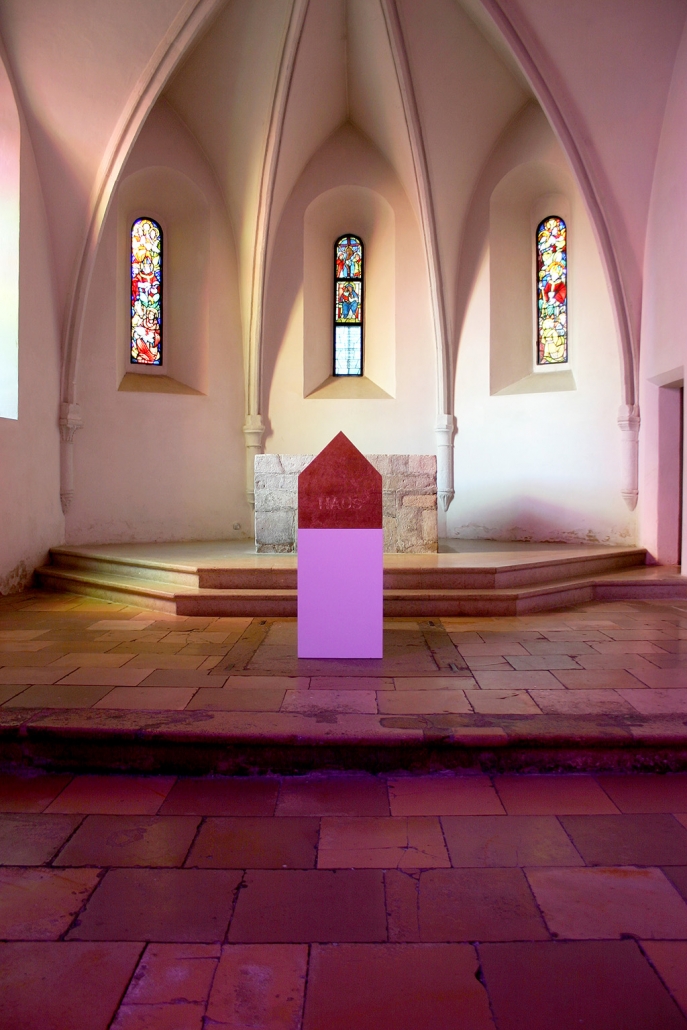
ART
People – Space – Character
In his independent artistic practice, Christof Cremer explores fundamental themes and aspects that emerge from the wide range of his professional fields. A key focus is on reflecting on traditions in art and architectural history and examining their significance in the present day.
>> Read more
Lent Installation 2008
in St. Ruprecht, Vienna
Schlaining Synagogue
in the former Schlaining Synagogue, Stadtschlaining
March 30, 2022
Former Synagogue in Stadtschlaining
With this restored synagogue, a place of remembrance and reflection has been created, but also a place of dialogue, curiosity, and “getting to know one another anew.”
The permanent exhibition, now complete, sheds light on the development of the Jewish community in Stadtschlaining. Through the objects and texts on display, Jewish life—both past and destroyed, as well as that lived today—here in Burgenland, as well as throughout the Jewish world, is presented and brought to life.
The central element of the exhibition is the symbolic form of a Star of David. The Star of David consists of six triangular black display cases. A black Star of David. But the display cases are illuminated—and so the star shines. A shining star that presents Jewish life, both historically and today. A glowing star representing the hope for a bright, shared future built on mutual understanding.
The former synagogue also houses a memorial dedicated to the Jewish population of Southern Burgenland, who were expelled and exterminated in 1938. The guiding principle, “Giving Space to the Absent,” is realized in the form of a fragmentary, stylized reconstruction of the interior furnishings—as a black shadow. The aim is to restore the spatial and synagogal context and to reconnect with the history of the synagogue and the Jewish residents of Stadtschlaining. By engraving the names and dates of birth, suffering, and death of the last Jews into the pews, these individuals and their personal histories are brought back to Stadtschlaining. In this way, they are rescued from the annihilation perpetrated by the Nazis. The memory of them, of their history, and of their fate remains alive. There is no gravestone bearing their names for the victims. Now that their names stand in the synagogue as a tribute to their memory, the installation serves as a gravestone and memorial. The installation defies any functionality or naturalism; it does not seek to be practical. It is black. Black as a shadow—the shadow of the past and the shadow of pain—as a hint of what once was here.
For a place like this—one that informs and moves people—to come into being, it takes people who develop and realize a shared vision and who work together intensively and with passion. The relevant institutions of the State of Burgenland, the lenders, as well as the Jewish Community of Graz, the Jewish Community of Vienna, LIKRAT, Misrachi Austria, the Austrian Jewish Museum in Eisenstadt, and the Burgenland State Museum.
Last but not least, I would like to thank the team led by Mag. Norbert Darabos for the trust they placed in my idea and concept! And to Prof. (FH) Mag. Awi Blumenfeld of the Jewish Community of Vienna, who, as the project’s academic and Jewish advisor, has guided the project with great passion.
Excerpts from the exhibition credits:
Chair of the Steering Committee for “100 Years of Burgenland”: Governor Mag. Hans Peter Doskozil
KBB – Kultur-Betriebe Burgenland GmbH, Franz Schubert-Platz 6, 7000 Eisenstadt
Friedensburg Schlaining Location
Management: DI Barbara Weißeisen-Halwax
Project Management and Overall Coordination: Mag. Tanja Stacherl, Christoph Langecker
Scientific Patron and Site Director: Mag. Norbert Darabos
Curated by: Mag. Christof Cremer
Academic & Jewish Advisor: Prof. (FH) Mag. Awi Blumenfeld
Exhibition Design, Artistic Direction, and Curation: Mag. Christof Cremer
Contribution to Preliminary Design: Mag. Franz Ehn
Detailed Planning, Bidding, and On-Site Construction Supervision: RIGEWA Riedner Gepp Waldhör Architekten ZT GmbH, Architect Matthias Riedner, Dipl. Ing.
Multimedia: ZONE Media GmbH
Graphic Design: DI Julia Oppermann
Illustration: Jovan Sertić
Structural design, exhibition design, display cases, and scenography: Winter Artservice
Project Leaders: Benjamin Reichert and Herbert Herl
Media Technology: Winter Artservice and cat-x exhibitions Prix KG
Project Manager: Florian Prix
Arthandling: Vienna Arthandling
Further information
ORF: Burgenland Today - Report on the Synagogue's Opening
Tent of God
Client:
Municipality of St. Ruprecht
Artistic Directors:
Christof Cremer
ART INSTALLATION FOR LENT
“… I have moved about in a tent.”
(2 Sam. 7:6)
During Lent, altarpieces are covered in many churches. It is not until the celebration of Jesus' resurrection that
they become visible again. The aim is also to sharpen our focus on what is essential.
This year, at Ruprechtskirche, nothing will be covered up; on the contrary, something will be
highlighted and brought to people’s attention. This, too, is meant to help us focus on what is essential.
Some associations that may come to mind when looking at the golden foil:
Canopies have been around for many centuries. On the one hand, they served as sun protection for the
ruler and as a clear indication of where his place, his seat, was.
Christians also adopted the canopy as a symbol of honor—for bishops, the pope, and
later also as a “heaven” above the tabernacle or during processions.
King David had the Ark of the Covenant, the sign of “I am here,” brought into a tent. The tent thus becomes
the place where God dwells.
In the Book of Revelation in the New Testament, we read: “Then I heard a loud voice from the
throne saying, ‘Behold, the tent of God (the dwelling place of God) among men!’”
The golden canopy above the altar is stretched like a tent over the place where, for
centuries, the death and resurrection of Jesus have been commemorated and the Lord’s Supper has been celebrated.
The golden foil appears to float, reacts to thermal currents, and is delicate and light as a feather. And yet, “
” offers protection: This tent was made using rescue foil, the kind used to wrap people in after accidents
. Rescue foil that refugees receive when they arrive on the mainland after a dramatic and life-threatening
journey across the sea.
The foil reflects light, casting a golden glow; it seems as though those seeking shelter and
safety beneath it are transformed into queens and kings.
The gold of the foil is also a reference to the upcoming Easter celebration, to the resurrection of Jesus.
The artist Christof Cremer, who created this art installation, says: “This tent, this foil
is also a symbol of Christ for me: He is our lifesaving foil.”
© Photo: Christof Cremer
Altar Covering – Lenten Installation
The project, conceived for Ruprechtskirche, explores the ancient ecclesiastical tradition of “veiling,” which dates back to the 10th century. As part of the 2005 Lenten installation, the altar was “veiled” using an artistically designed cover. Printed on the covering is an image of the altar in a color gradient ranging from purple to white.
The print resembles an X-ray; it makes the altar visible, brings it “to light,” and is thus translucent in a certain way. Through this design, the structure of the altar—the masonry block—is brought closer to the viewer in terms of its form and complexity; the viewer is guided toward a new way of seeing. The altar is veiled and yet—or perhaps precisely because of this—
particularly present. The veiling of the altar creates a new sense of space for visitors and participants in the liturgical celebrations; it enables a new, profound
experience of what is to come. The covering also alludes to the Book of Zephaniah, the biblical text read during the 2005 Lenten season at the services in St. Ruprecht
, which leads from repentance to hope. During the Easter Vigil, the altar is unveiled. The altar is rediscovered.
The project is a collaborative effort by Julia Oppermann and Christof Cremer.
Rule of St. Benedict
at the Benedictine Abbey of Admont, 2007
Approximation
The fundamental idea underlying this work is the statement from the Constitution on the Sacred Liturgy of the Second Vatican Council: In the earthly liturgy, we participate as a foretaste in that heavenly liturgy which is celebrated in the holy city of Jerusalem, toward which we are journeying as pilgrims (Sacrosanctum Concilium I,8).
The installation symbolizes the journey of humankind, of Christians, and of pilgrims. The baptismal font and the altar serve as a link between Paradise as the origin—as described in the Book of Genesis in the Old Testament—and the promise of Paradise in the New Testament. They represent the source—the Eucharist—from which the Christian’s life draws sustenance. But they also represent the beginning and the end.
A path made of sand—a reference to the journey of the people of Israel through the desert—leads the viewer, accompanied by excerpts from the text describing the Garden of Eden in Genesis, from the baptismal font to the altar, which bears texts from all four Gospels (Palm Sunday, Holy Thursday, Good Friday, Easter Morning), as well as the Lord’s Prayer. Surrounding the altar are the vestments—as used in the celebration of the Eucharist—symbolizing, as it were, a foretaste of the heavenly liturgy. Integrated into the installation are quotations from the Rule of St. Benedict as wisdom for life and faith, serving as signposts on the pilgrimage to God and thus to Paradise.
This post is also available in: German